Why a knob?
Because turning is the one thing a mouse does badly and a hand does perfectly. We just had to give the hand something worth turning.
wdth 125 Turn the dial. The headline narrows and widens with it.
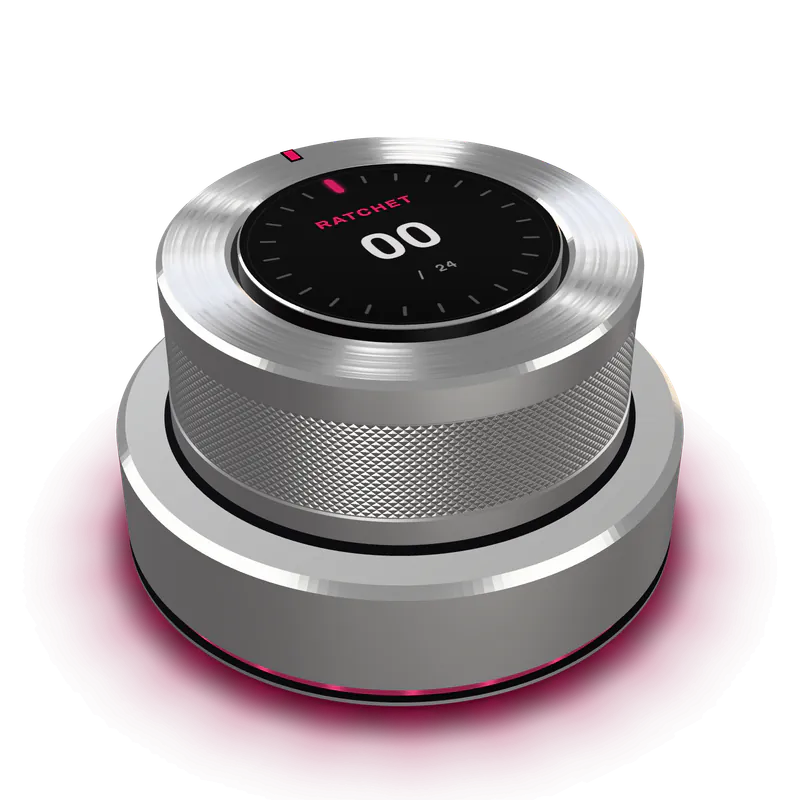
- Every knob on your screen is a picture of a knob.
- You turn it with a device built for pointing.
- Your hands know better. They can find a frame, a semitone, a line of code, if something tells them where it is.
- So we built one real knob that can become all of the others.
- It clicks where the software says a click belongs. It stops where the range ends. It snaps to what matters.
- Software you can feel.
Why haptics?
A click is information.
When a knob clicks, your hand knows it moved one step without your eyes checking. A wall tells you the range is over. A spring tells you how far you are from center, and the pull gets stronger the further you go.
Screens can show all of that. Only a motor can make you feel it, and feeling is faster: your hand has corrected before you finish reading the number. That is why editors still buy jog wheels and mix engineers still buy fader banks. We wanted one object that could be all of them, and change its mind when you change apps.
It started with someone else’s knob.
In November 2023 Mira Castellanos built a SmartKnob, Scott Bezek’s open-source haptic knob, from the published files. She wanted to know if a motor could fake a click convincingly. It could. It could also fake a spring, a wall and a ratchet, and she spent a week turning it instead of finishing the record she was mixing.
The idea that stuck was not the knob. It was that the feel could follow the software. Every other knob she owned was born with its clicks. This one could be told.
Oskar Nyberg had spent years designing lab instruments, objects that have to be exact before they are allowed to be beautiful. He turned the prototype once, said it was too light, and milled a body for it that weekend. It was still too light. That part of the story is below.
- Mira Castellanos Firmware and haptics
- Ten years writing motor control for camera gimbals. Nights mixing records for friends, with a mouse, badly.
- Oskar Nyberg Industrial design and machining
- Designed lab instruments for a living. Learned to run a CNC mill because waiting three weeks for a prototype felt worse.
Detent Labs, Mira and Oskar are fictional. Detent is a concept product, and this site is a design and engineering demonstration.
From P0 to the production line.
Seven builds in three years, each with the one number that decided what came next.
-
P0
A weekend knob
Mira builds a SmartKnob from the open-source files and does not put it down for a week. It has one profile she keeps retuning at 2 a.m.
1 knob, no plan
-
P1
Our own feel engine
New firmware from scratch, built around one question: how fast can the feel change when you switch apps? The first answer was not fast enough.
38 ms app switch to new feel
-
P2
The first machined body
Oskar mills the housing from a single billet of 6061. It is beautiful and it weighs 290 g, which is exactly light enough to skate across the desk when you flick it.
290 g too light
-
P3
Solid base, round screen
We stop hollowing the base and add the round display. The dial now stays where you put it and tells you what it is controlling.
412 g stays put
-
EVT
Forty strangers
Engineering validation units go to editors, mix engineers, designers and developers we had never met. Their first request, from 23 of them, became Magnet.
40 units, 40 testers
-
DVT
Break it on purpose
Drop tests, heat soak, and a rig that turns the knob until the bearings give up. They did not give up.
1,000,000 turns on the test rig
-
PVT
Off the production line
Five hundred units from the real line, with real tolerances. The same firmware you can read on GitHub runs on every one.
3.6 ms wired latency
-
B1
February 2027
Batch 1 ships
The first production run goes to the people who reserved one. We will post the date it leaves, not a quarter.
2,000 Founders Editions, then no more
Four things we will not trade.
-
Local-first
No account, no cloud, no telemetry unless you turn it on.
Profiles live on the dial, so it feels right on a computer that has never seen Detent Studio.
-
Open
Firmware under Apache-2.0. SDK in TypeScript and Rust.
Profiles are plain JSON. You can diff a feel, review it in a pull request, and fork ours.
-
Repairable
Four Torx screws and the whole thing comes apart.
Battery, foot and knob cap are sold as parts, with prices on the support page.
-
Honest
Real dates, a refundable deposit, a numbered run that really ends.
The Founders Edition stops at 2,000. And this site says plainly that Detent is a concept.
What’s next.
Dates we are confident in are dates. The rest are seasons, and we will say so when they move. Every change lands in the changelog.
-
Now
Beta on 500 desks
Firmware 0.9 and Studio 0.14 on every PVT unit. The SDK is public and taking pull requests.
-
December 2026
Firmware 1.0 and Studio 1.0
Launch software: profiles for 13 apps built in or by plugin, every community profile that passes review, and system controls everywhere else.
-
February 2027
Batch 1 ships
Reservations are filled in order. Batch 2 follows in April 2027.
-
Spring 2027
Linked pairs
Two dials, one profile set: scrub with your left hand, zoom with your right. Firmware 1.2.
-
Summer 2027
Profiles per browser tab
A browser extension so web apps get their own feel instead of sharing one. Studio 1.3.
-
After that
Not Detent Two
A profile library inside Studio, more integrations, longer battery. A second product waits until the first one is right.
A note from the founders
We built the thing we wanted on our own desks. If it has not earned a place on yours after 60 days, send it back. If it does, tell us what it should feel like next.
Mira and Oskar
One email when the list opens 10.20. Nothing else.
Free. Every friend who confirms earns you a reward.
Fully refundable. Locks the $299 launch price.
$299 until 12.04. Free shipping.
$349. Free shipping, 60-day studio trial.